
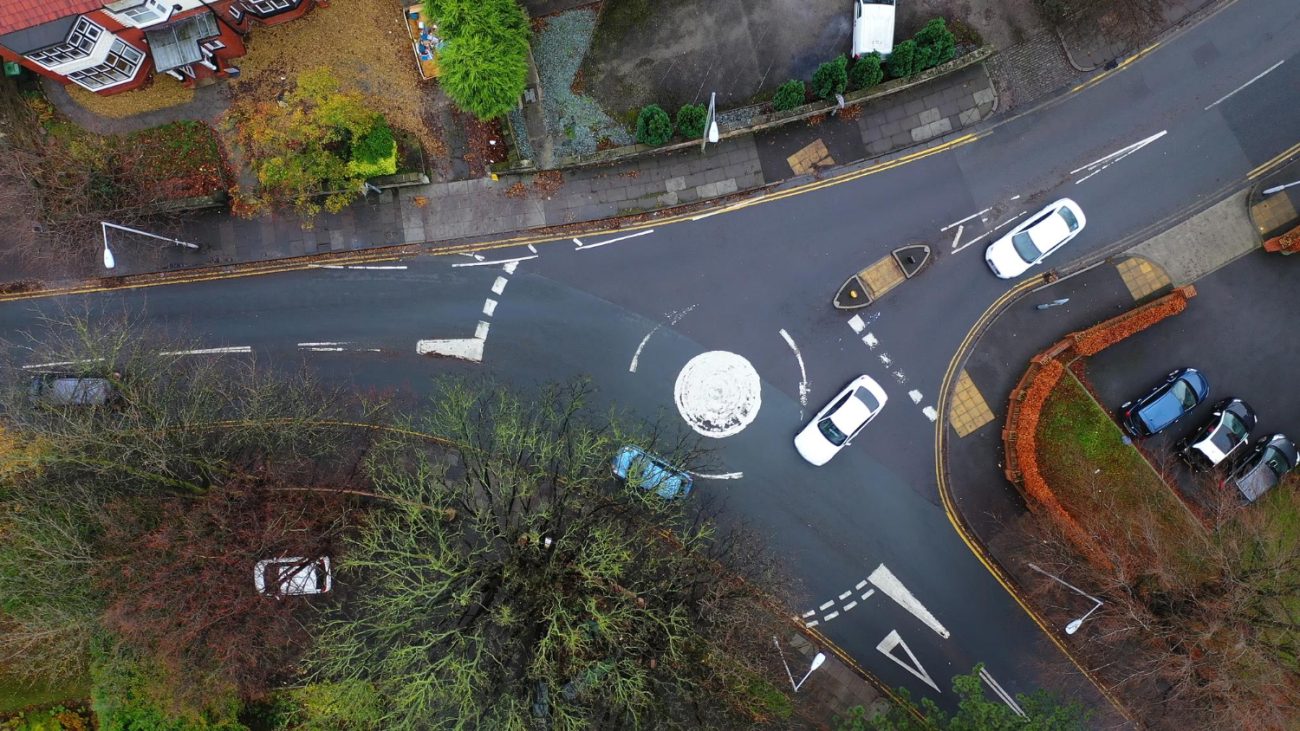
Get to grips with roundabouts – why and how they should not be intimidating.
Like them or loathe them, roundabouts are pretty much everywhere in the UK. They have many shapes and sizes – mini roundabouts (where the centre is made of paint), small and medium roundabouts, multi-lane and spiral roundabouts. Some aren’t even round!
So, why do learners struggle with them? Are there any tips and strategies to approach them and deal with them confidently?
In this post, I will address what makes roundabouts seem intimidating to some learner drivers, and list some tips to make them less so.
Why do I hate roundabouts?
‘I hate roundabouts!’ is a phrase I hear a lot from some learners.
Ask yourself which part of negotiating roundabouts you hate. Do you get confused on the approach? Do you struggle with judging a safe gap? What about worrying about stalling as you set off? Are you feeling under pressure from other road users?
Identifying which element will really help your driving instructor to come up with a teaching strategy to help you. There’s a lot going on, for sure, so don’t try and boil the ocean by getting it all right every time on your own. Ask your instructor for support with one element at a time.
Tips to make roundabouts less intimidating
Firstly, remember that traffic on the roundabout has priority, and you must normally give way to traffic approaching you from your right. Just like turning left at a T-junction on to a one-way street, you need to judge a safe gap and join the roundabout without making another road user slow down, stop or change direction.
I’ll break it down into four stages:
- Approach
- Observe
- Emerge
- Leave
Approach
Give yourself time. Getting your approach speed right can mean the difference between taking the first safe gap without having to stop, and stopping and hesitating at every roundabout you meet.
Unless road markings tell you anything different, to turn right, you should approach in the right lane or positioned towards the centre markings if there are no designated lanes.
For going ahead or turning left, you should be in your normal driving position on the left.
The options available to you will be greater if you bring your speed down – don’t try and keep up with traffic, but approach in your own time at your own pace.
Observe
The earlier you begin scanning the roundabout for a gap, the easier you will find one. Start looking as soon as you can see traffic clearly, well in advance of the give-way line. Keep your head moving – from traffic approaching to traffic in front of you.
It’s very easy to fixate on individual vehicles rather than looking at the traffic flow as a whole. So, shift your thinking to looking for gaps rather than looking at individual vehicles.
Try to notice what traffic is doing – note the following clues:
- Position
- Speed
- Angle
Position – if the traffic is on the outer edge of the roundabout, they may be leaving. If it is towards the centre, it may be staying on.
Speed – if the traffic is slower, it may be continuing around the roundabout; if it is accelerating it may be leaving
Angle – if you can see the fronts of the vehicles, traffic may be staying on the roundabout, if you can see the sides the traffic may be leaving.
These are clues, not rules, and notice at no point do I mention signals! Drivers are notoriously bad at signalling correctly, so don’t rely on indicators in isolation to judge whether it is safe to emerge.
A gap should be large enough for you to join comfortably, without harsh acceleration and without making another vehicle slow down, stop or swerve. You should prepare the car to move before the gap comes round in front of you – preparation takes valuable seconds, so don’t leave it until the gap is right there.
Don’t stare – keep your head moving between your right-hand window and your windscreen. You should be looking forwards when you start to move into the gap – do not leave this last observation to chance. The vehicle in front may not have anticipated a gap and could still be there, leading to a rear-end shunt.
Emerge
Your take off should be brisk but not harsh – progressive, purposeful and confident driving is key to roundabouts. If you’re worried about stalling, this post will help.
If you’re turning right, keep to the right until you are approaching the exit before yours. Lane markings may assist you, and it is important to follow these if they are present. At roundabouts without lane markings, mentally divide the road around the centre island into two (the ‘topping’ and the ‘crust’ of the pizza, if that helps!) You should check your centre and left mirrors and your left side, and signal left before moving out from the topping into the crust.
Leave
You should leave the roundabout in your normal driving position on the left. If you have moved successfully into the crust of the pizza before your exit, this will be easy.
Blockers
What is a blocker?
Remember that traffic coming from the right has priority. This means that drivers waiting to enter the roundabout before you also have to give way to the right.
When they stop at their give-way line (on the entrance before yours), that’s a clue that they have seen a vehicle coming around that perhaps you can’t see yet.
This behaviour can create a gap into which you can safely emerge.
Anticipating the actions of other drivers trying to emerge on to the roundabout is another clue that a gap is coming.
Roundabouts don’t have to be intimidating
When you’re learning, roundabouts can look complicated – there can be multiple lanes, traffic seems to be coming from every direction, people signalling, not signalling. Everyone knows what they’re doing except you!
Don’t try and master everything at once – slow the approach, start looking early, and look for gaps, not vehicles. Use the position, speed and angle of traffic to anticipate what other drivers are likely to do. Prepare the car before the gap arrives, and look forward before you move.
Remember the four stages: Approach, Observe, Emerge, Leave.
With practice, the whole process will become natural and you’ll eventually find yourself reading the traffic, anticipating the gaps and positioning the car almost without having to think.
It’s just another junction – it’s just waiting for your favourite topping.
