
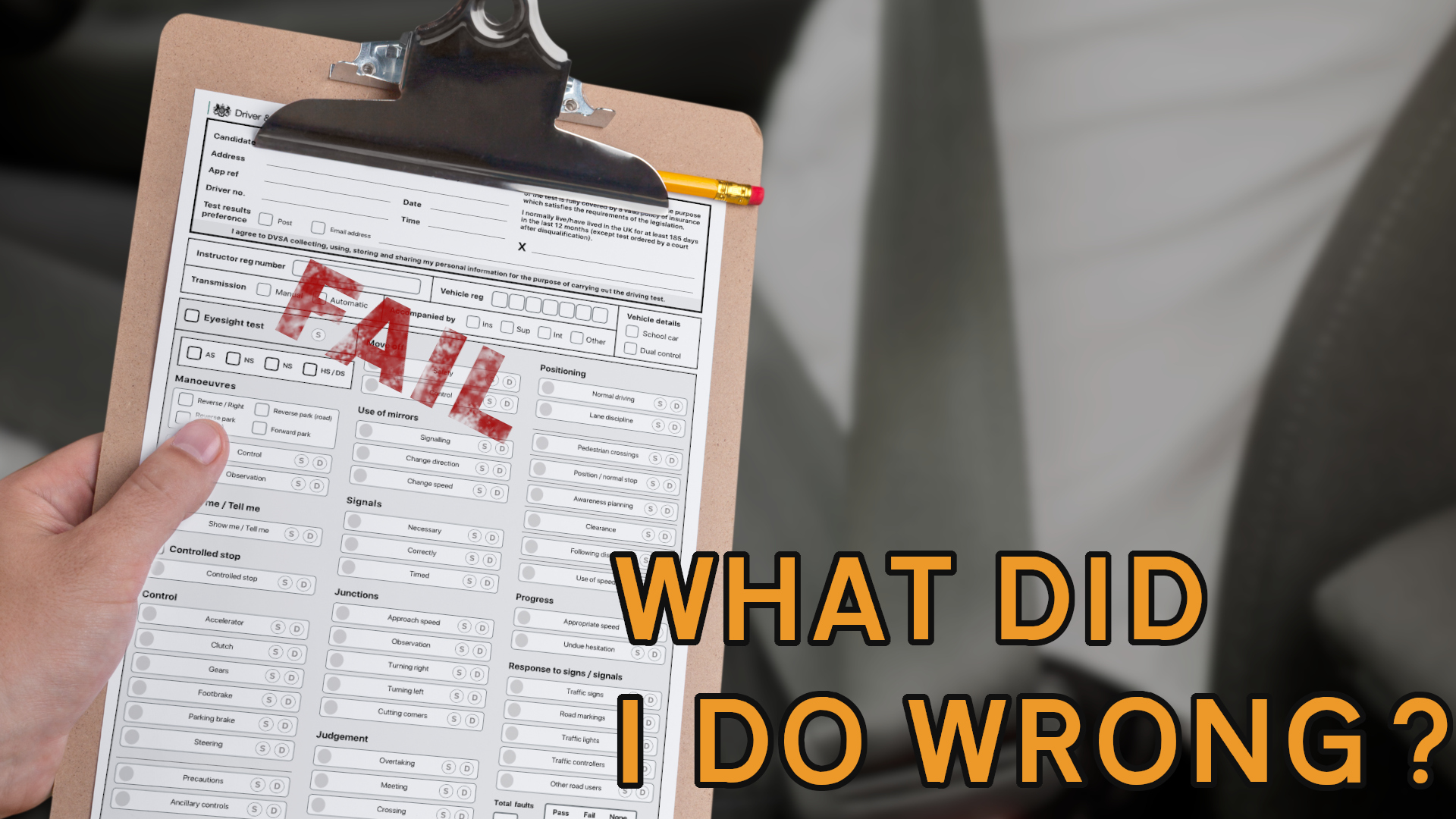
Here’s a quick TL:DR summary
Q: What counts as a fault on a driving test?
A: A fault is recorded when your driving falls below the standard expected of a safe and competent driver.
Q: How many faults can you have and still pass?
A: You can have up to 15 driving faults and still pass, as long as no serious or dangerous faults are recorded.
Q: What is the difference between a driving fault, serious fault, and dangerous fault?
A:
- Driving fault: a low-risk mistake
- Serious fault: something that creates a potential risk
- Dangerous fault: something that results in actual danger
Q: Can you still pass if you make a mistake?
A: Yes. You are allowed to make mistakes, as long as they remain low risk and are dealt with safely.
Q: Can the same mistake be marked differently?
A: Yes. The outcome depends on the situation, not just the action.
Q: Is an awareness of test faults helpful to my learning?
A: The short answer is yes, but it is often more useful to think in terms of safety outcomes rather than test faults.
Would that have been a fault on my test?
This is one of the most common questions I hear during lessons. It is a good question, but not always the most helpful one.
Most learners are trying to work out what is “allowed” and what is not. But the driving test does not work like that. It is not about avoiding every small mistake, but showing that you can drive safely and competently.
The examiner will not start by looking for faults. They assess an expected outcome, which is the standard of a safe and competent driver in any given situation. A fault is recorded when your driving falls below that standard.
That means:
- you are not expected to be perfect
- small mistakes are part of normal driving
- what matters is the level of risk and how you deal with it
There are three types of faults, plus situations that are not worth recording.
Not noteworthy
An example would be approaching a roundabout and forgetting to change down a gear. You stay in third gear, and the car struggles slightly. It would have been better to use second. The roundabout is clear, and there is no other traffic, so the mistake does not create any safety issues.
In this example, the gear choice is not ideal, but the overall driving remains safe. The examiner considers the full situation, and no fault would be recorded.
Some minor deviations are simply not worth recording. This is worth remembering if you think you have made a mistake, so you do not end up overthinking every detail.
Driving fault
A driving fault is where your driving falls below the expected standard, but no one is put at risk. You can have up to 15 of these and still pass.
An example would be arriving at a junction without properly assessing whether a gap is available, and coming to a stop when you could have continued.
In this case, a lack of early observation (perhaps due to approach speed or overthinking the gear) leads to hesitation. This may be recorded as a driving fault for Undue Hesitation, or possibly Approach Speed, depending on how the examiner judges the cause.
The desired outcome would be to assess traffic earlier and prepare the car to move, rather than stop unnecessarily. The deviation from that outcome creates the fault. The examiner then considers the level of risk, and if there is none, it remains a driving fault.
Serious fault
A serious fault is recorded when a situation creates a potential risk. Nothing may actually happen, but the possibility of danger is there.
An example would be approaching a roundabout to turn left, seeing space in your lane, and emerging when there is traffic already on the roundabout with priority.
The Highway Code (Rule 185) states that you must give priority to traffic approaching from the right. By emerging, you have not done so.
The risk here is clear: if another vehicle chooses to take the same exit, a collision could occur.
The desired outcome is to give way appropriately and emerge only when it is safe. Because the situation creates a clear potential risk, this would be recorded as a serious fault for Junctions – Observation.
Dangerous fault
A dangerous fault is when actual danger occurs, meaning another road user has to take action to avoid harm, or the situation becomes unsafe.
An example would be joining a dual carriageway from a slip road without matching the speed of the traffic already on the carriageway.
Traffic on the slip road must give way to traffic on the carriageway, so it is important to merge into a safe gap. Misjudging that gap and forcing your way in, causing another vehicle to brake noticeably or take avoiding action, would be a dangerous fault.
The desired outcome is to match speed, signal clearly, observe effectively, and join a safe gap without affecting other traffic. In this case, actual danger has occurred, so it would be recorded as a dangerous fault. The exact category may vary depending on whether the examiner considers the main cause to be observation, planning, or speed.
Can the same mistake be marked differently?
Yes, and this is what many learners don’t realise, because it is not just what you do, but what is happening around you.
The examiner considers:
- the situation
- the level of risk
- the outcome (or potential outcome)
For example, forgetting a mirror check:
- on an empty road, it may be a driving fault
- with traffic nearby, it could be a serious fault
- if someone has to react, it could be a dangerous fault
The same mistake can lead to very different outcomes depending on the situation.
Repeated faults
If the same driving fault happens more than once, it can be assessed as potentially dangerous, because it shows a pattern rather than a one-off lapse.
A safe driver is expected to be consistent, with good discipline across multiple areas that together make a competent drive.
For example, not checking your right blind spot before moving off. If it happens once, you may receive a driving fault, depending on the level of risk. If it happens repeatedly, even in low-risk situations, it suggests a habit. At that point, the examiner is considering whether it is only a matter of time before that habit leads to danger.
You are allowed to make mistakes
This is something I make clear to all my pupils: you can make mistakes on your test and still pass.
What matters is maintaining control, being aware of others, and dealing with situations safely.
The examiner is not looking for perfection. They are assessing whether you can drive independently without putting yourself or others at risk.
A better question to ask
Instead of asking “Would that be a fault?”, a more useful question is “Did that create a risk?” or “Did I deal with it safely?”
That shift in thinking moves you away from test-focused driving and towards real-world safe driving.
I will always answer the original question honestly (whether a fault would be recorded, and what type) but I will also ask why you think it would be a fault. That is often where the real learning happens. If you reflect on the reason the DVSA would classify your mistake as a fault, you will better understand it, rather than just programming your brain to avoid that situation in future. The next time it happens, you may miss an opportunity to improve, because you’re still thinking about that particular situation where it happened before.
Final thought
The driving test is not about catching you out, it is an assessment of whether your driving is safe, consistent, competent, and independent.
You do not need to be perfect, but you do need to be safe. If you would like an impartial assessment of your driving, or a mock-test, please get in touch and we’d be happy to help!
