
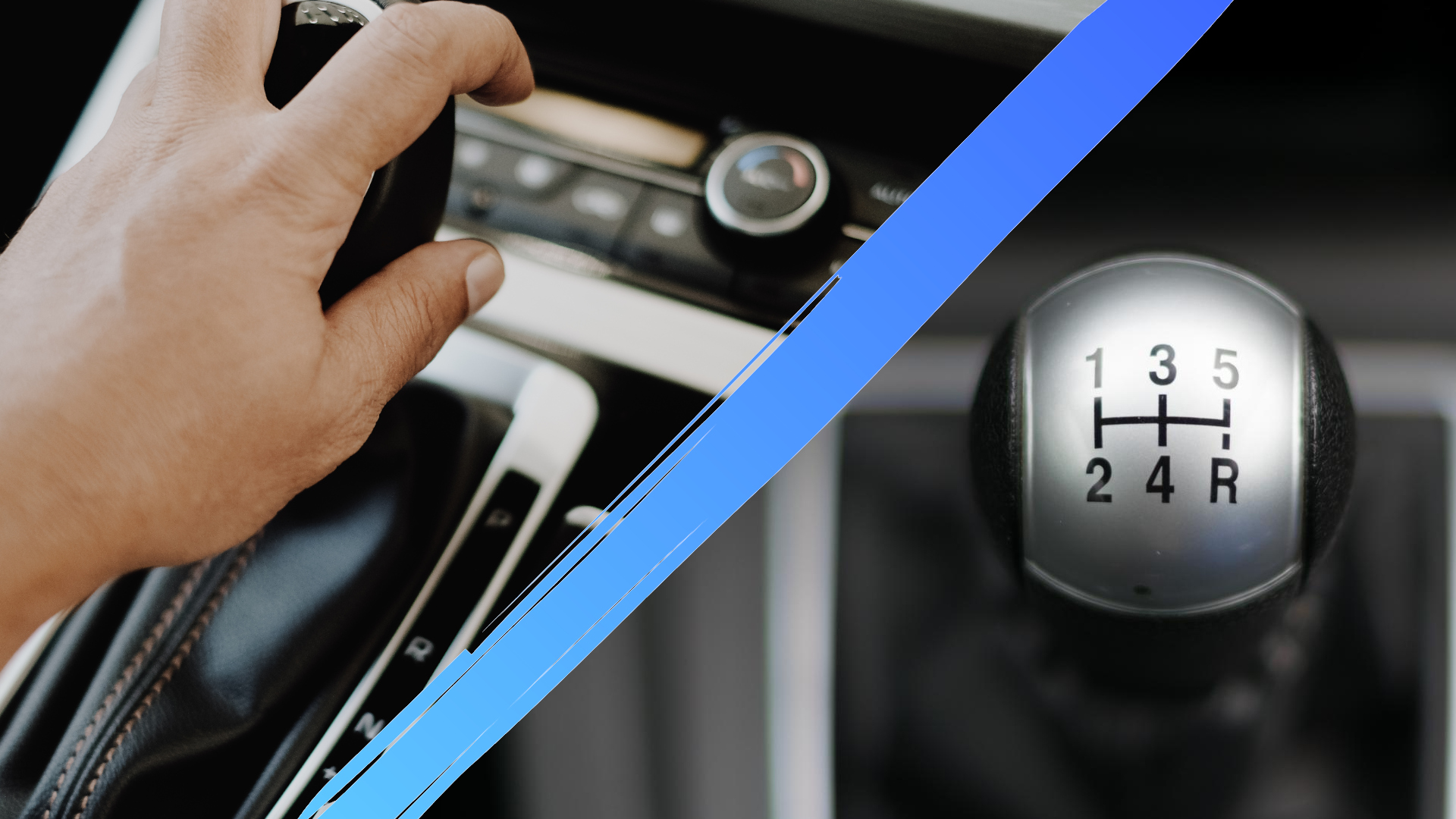
What are the pros and cons of learning in an automatic car versus a manual?
Increasingly, drivers are learning to drive in an automatic transmission car, which has benefits and drawbacks. At Tayton Driver Training, driving lessons are available in either manual or automatic cars. Here, we look at the hows and whys of learning in both.
What is the difference?
In manual cars, the gears are selected by the driver, using the clutch pedal to disconnect the engine from the wheels while a new gear is chosen. The driver decides which gear to use based on the desired speed and/or acceleration.
Automatic transmissions come in different types, but they all remove the need for the driver to select a gear, and they do not have a clutch pedal. The transmission changes gear automatically based on the vehicle’s speed. To achieve more acceleration, “kick-down” is enabled by pressing more firmly on the accelerator in some transmissions.
UK rules
You can take the UK driving test in either a manual or an automatic car. However, if you pass the test in an automatic, you will only be licensed to drive automatics, not manuals. If you pass your test in a manual car, you will be licensed to drive both.
Currently, about a third of cars in the UK are manual — a significant reduction compared with previous decades. The main reason is the rise of electric vehicles (which are exclusively automatics). Car makers have responded to this shift by discontinuing manual models in some of their ranges.
Which should I choose?
We always advise pupils to think about their future driving needs. Will you be working in a job that requires you to drive a company vehicle? If so, would an automatic option definitely be available?
Automatic cars are generally more expensive to buy than manuals and often have higher insurance premiums.
Think about running costs: automatic and manual cars do not differ much in fuel consumption, but repair costs for an automatic transmission are usually higher due to its more complex mechanical parts. This is one reason driving lessons in a manual car are generally cheaper — instructors have lower running costs.
Automatic cars are much easier to drive, however. You do not need to operate a clutch pedal, and there is no need to decide which gear you want. With less to think about mechanically, you can focus more of your awareness on the road.
Some drivers prefer manual transmission, as it gives a greater sense of control and acceleration — particularly useful on faster rural roads with bends and hills. It allows early engine braking before corners and better acceleration preparation for climbs.
On longer commutes, automatics are definitely worth considering, as they reduce some of the fatigue involved in driving.
So, it comes down to your needs, preferences, and the costs you are willing to bear. Think carefully, though, before committing to taking your test in an automatic — you will need to take the test again if you change your mind later (although you will not have to take another theory test).
The future
Due to the UK government’s stated aim of banning the production of fossil-fuelled cars by 2030, it is likely that the production of manual cars will cease entirely at that point.
However, there will still be manual vehicles on the road for several decades, until the supply and demand for fossil fuels declines. Then, we may see manual cars as relics of a bygone era — much like when we used to start car engines with a hand crank!
